
A HUMAN-CENTERED MODEL FOR ENTERPRISE COMMUNICATION CAPABILITY
Build Communication Capability Around How People Understand, Act, Trust, and Learn
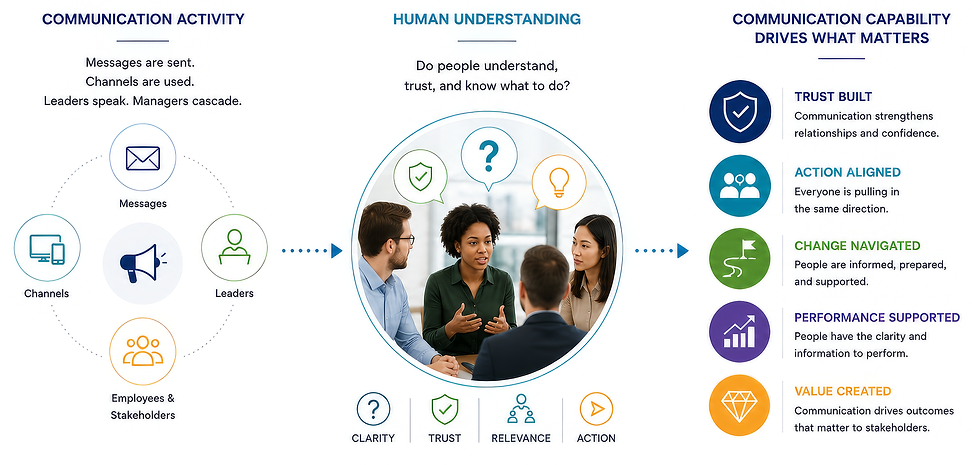
Organizations can send messages, hold meetings, publish updates, and launch campaigns while people still remain unclear, skeptical, overloaded, or unable to act.
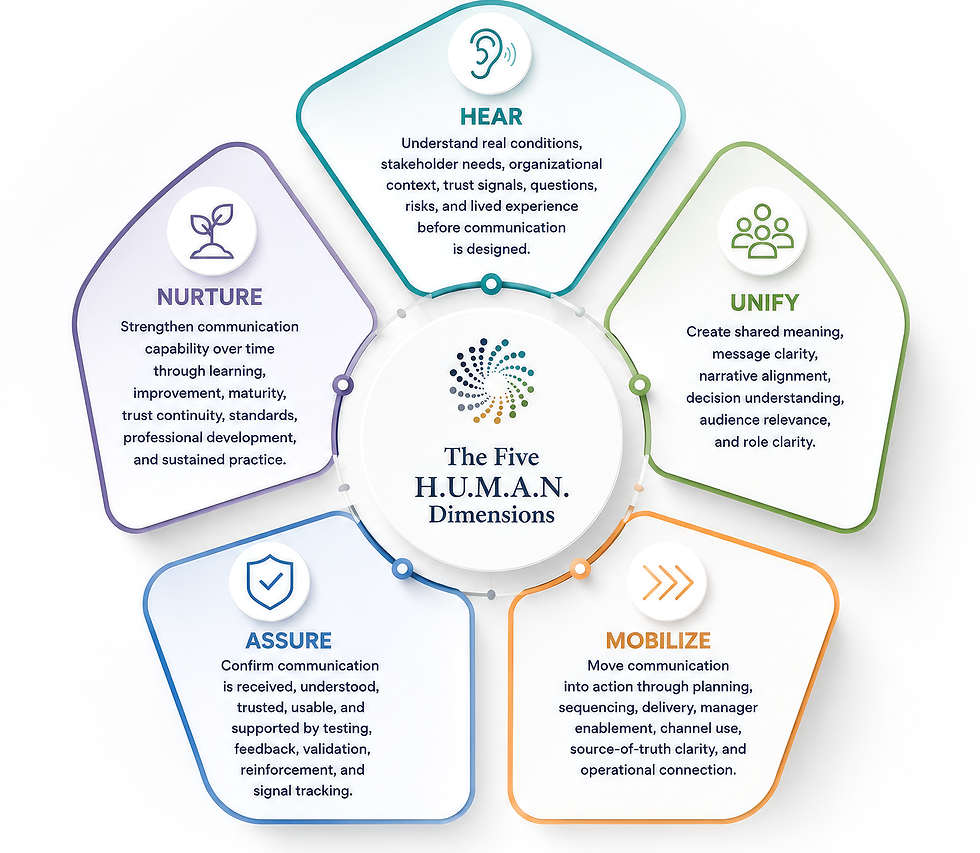
The H.U.M.A.N. Enterprise Communication Capability Model™ helps organizations strengthen the conditions communication needs to create shared meaning, trust, alignment, coordinated action, adaptation, learning, and stakeholder value across the real environments where work happens.
Communication Is Too Important to Depend on Messages Alone
Strategy, priorities, change, culture, customer experience, risk, safety, reputation, and stakeholder trust all depend
on people understanding what matters, why it matters, what is expected, and how to act together.
When communication is treated mainly as content, channels, or campaigns, organizations can increase activity without improving the conditions that make communication work. Meaning fragments. Managers carry unnecessary burden. Employees fill gaps with assumptions. Stakeholders lose confidence. Decisions and priorities become harder to reinforce.
The H.U.M.A.N. Model makes the broader capability visible. It helps leaders, communication professionals, managers, functions, and partners examine the connected responsibilities, practices, systems, and learning needed to produce more reliable outcomes.
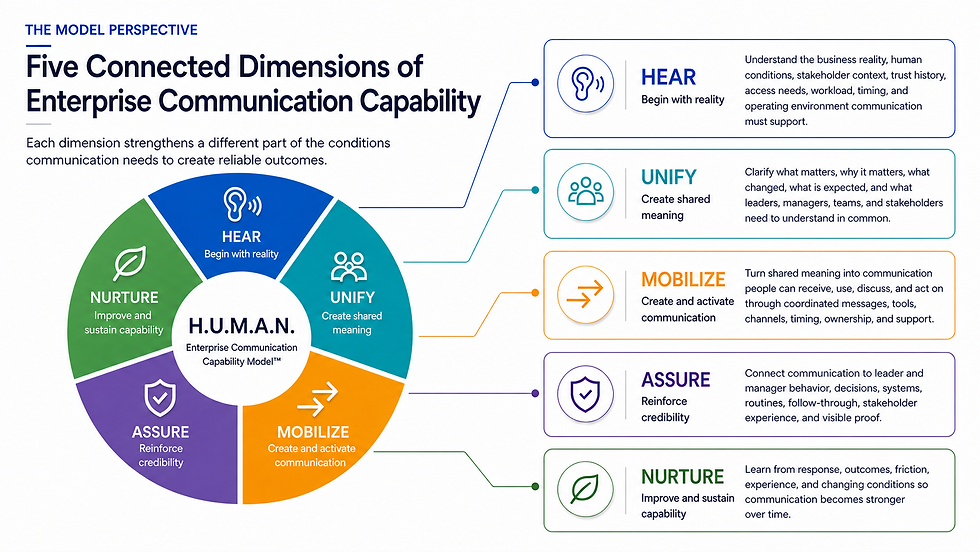
Five Connected Dimentions of Communication Capability
The name H.U.M.A.N. is intentional. Communication capability must operate across the enterprise and support measurable outcomes, but it must remain grounded in how real people understand, interpret, trust, act, reinforce, and learn.
Connected Capability, Not a One-Time Checklist
The Dimensions describe connected conditions, not five isolated tasks. HEAR grounds the work in reality. UNIFY establishes meaning. MOBILIZE makes communication usable and actionable. ASSURE tests whether communication remains credible after delivery. NURTURE turns response and experience into learning that strengthens the next effort.
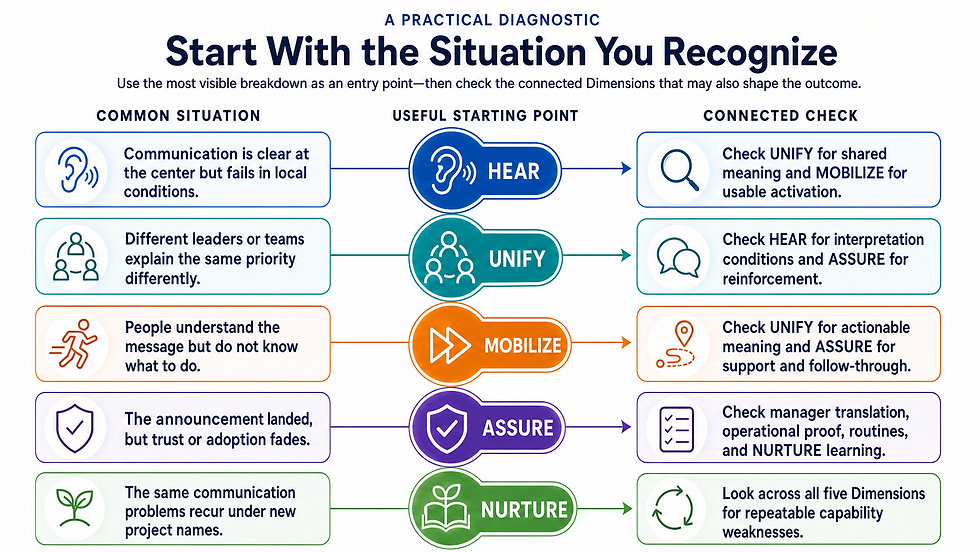
Organizations may enter the Model through the Dimension most relevant to the breakdown in front of them. They should still look across the full system, because weakness in one Dimension can reduce the value of work in the others.
The Model Extends Beyond the Communication Function
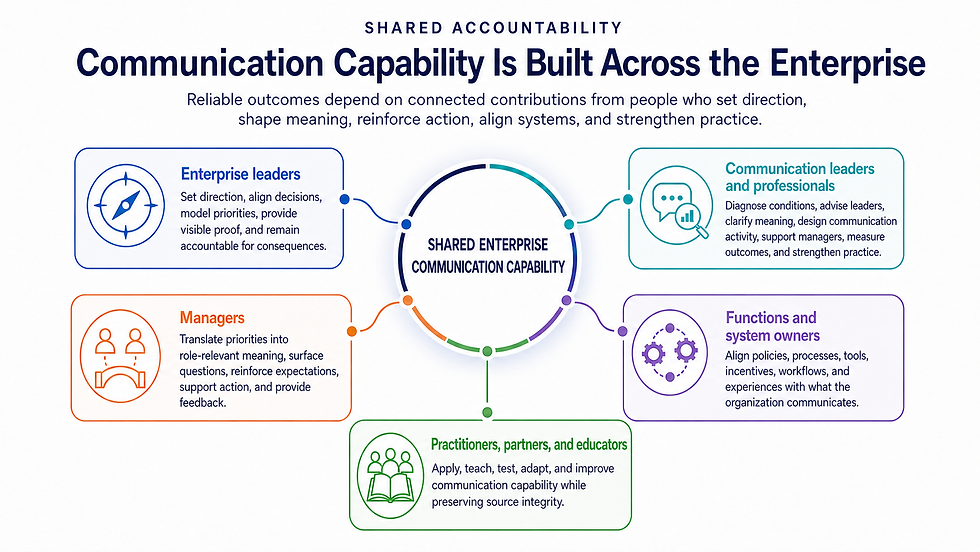
Communication professionals play a critical role, but enterprise communication capability cannot be owned by one team alone. It also depends on executives who set direction, leaders who decide and model behavior, managers who translate and reinforce meaning, functions and systems that shape experience, and stakeholders who judge whether communication is relevant and credible.
AI Can Accelerate Capability - or Accelerate Existing Gaps
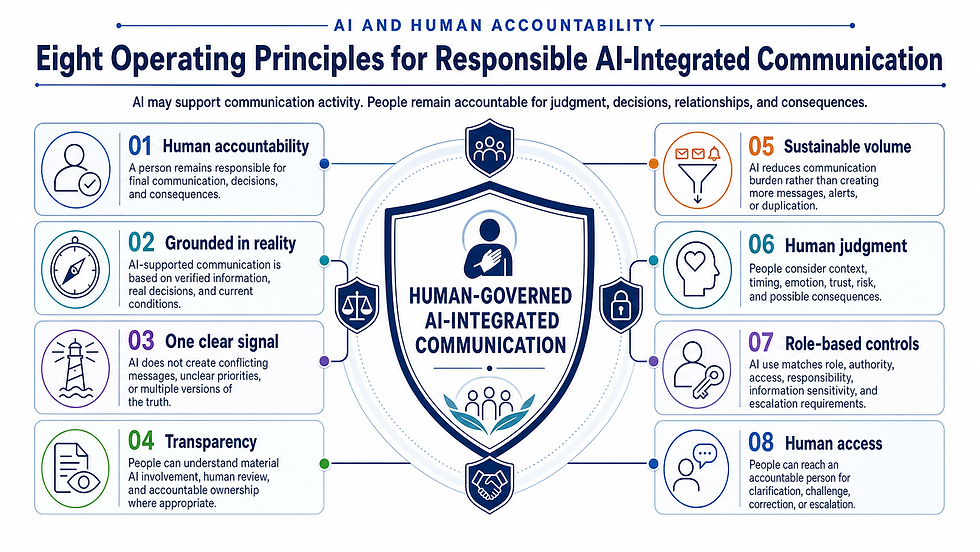
AI can increase communication speed, scale, accessibility, analysis, and workflow support. It can also accelerate ambiguity, saturation, fragmentation, hidden dependency, exposure, de-skilling, and loss of trust when governance and human judgment do not mature with it.
The H.U.M.A.N. Model treats AI as a capability accelerator operating inside human and enterprise conditions, not as an accountable communicator, final interpreter, decision owner, or substitute for the people responsible for organizational consequences.
From Diagnosing a Breakdown to Strengthening Capability
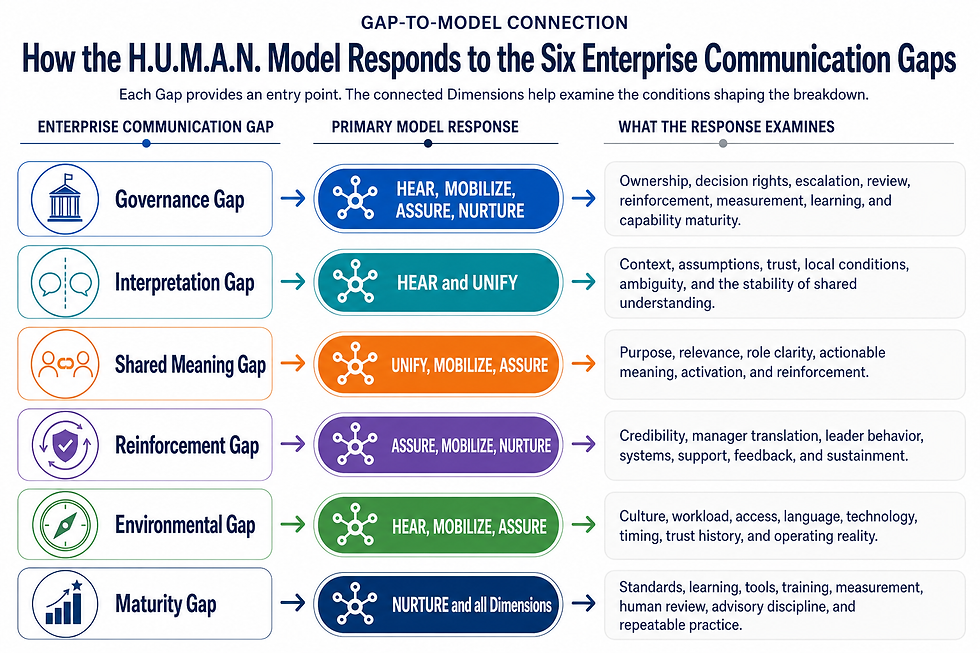
The Six Enterprise Communication Gaps™ help identify deeper conditions weakening understanding, trust, alignment, coordinated action, adaptation, or stakeholder value. The H.U.M.A.N. Model helps organize the capability response.
One Model, Multiple Communication Environments
The Model can be applied wherever people must understand meaning, build trust, align around direction, coordinate action, adapt, learn, or create stakeholder value.
-
Leadership Communication
-
Internal Communication
-
Frontline Communication
-
Change and Transformation
-
Technology and Digital Adoption
-
Issues Management
-
Stakeholder Communication
-
Brand and Growth
-
Executive Thought Leadership
The Model remains consistent across these environments, while application adapts to the situation, people, risks, responsibilities, and outcomes involved.
Start With a Practical Resource
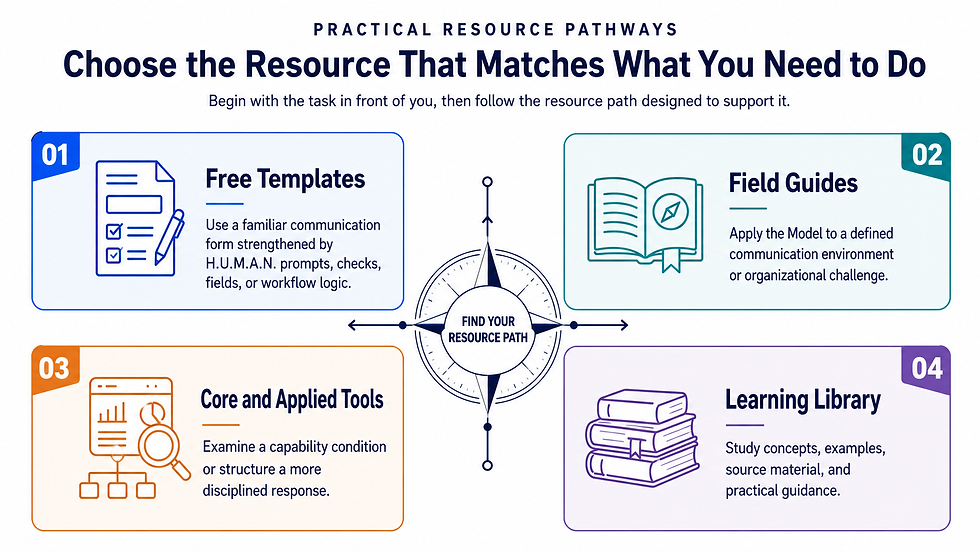
CCI resources translate the Model into familiar, usable forms such as templates, field guides, tools, examples, and learning resources. The H.U.M.A.N. lens should shape the work itself—not sit beside it as decoration or heavy methodology.
A Public Model Grounded in CCI's Source Architecture
CCI develops and stewards the H.U.M.A.N. Model as part of its public-benefit work to advance enterprise communication capability. The Model is grounded in The Foundational Reference For Enterprise Communication Capability™ and translated into Dimension guidance, Standard Expectations, applications, educational resources, and practical tools.
Responsible use requires consistent terminology, source integrity, human stewardship, transparent version control, and clear accountability for how human- and AI-supported content is developed and maintained.
Strengthen Capability Over Time
Explore articles, examples, source updates, applied resources, and learning that connect the H.U.M.A.N. Model to current enterprise communication challenges.
Frequently Asked Questions
What is the H.U.M.A.N. Model?
The H.U.M.A.N. Enterprise Communication Capability Model™ is CCI's human-centered, enterprise-focused, and outcome-oriented model for organizing communication capability across five connected Dimensions: HEAR, UNIFY, MOBILIZE, ASSURE, and NURTURE.
What does H.U.M.A.N. stand for?
H.U.M.A.N. stands for HEAR, UNIFY, MOBILIZE, ASSURE, and NURTURE. Together, the Dimensions help organizations begin with reality, create shared meaning, activate usable communication, reinforce credibility, and learn over time.
Is the H.U.M.A.N. Model a linear process?
No. The Dimensions are connected capability conditions rather than a rigid sequence. Organizations may begin with the most relevant breakdown, then look across the full Model for related strengths and weaknesses.
Who is responsible for applying the Model?
Communication professionals are central, but capability is shared across executives, leaders, managers, functions, systems, practitioners, and partners whose decisions and behavior shape communication outcomes.
How does the Model relate to the Six Enterprise Communication Gaps?
The Six Gaps help diagnose why communication is breaking down. The H.U.M.A.N. Model organizes the connected capability response an organization can strengthen.
How does the Model address AI?
AI is integrated across all five Dimensions as a capability accelerator. Accountable people remain responsible for decisions, final communication, review, transparency, escalation, and consequences.
How many Standard Expectations are in the Model?
CCI's current website architecture specifies 65 Standard Expectations. The authoritative count and Dimension allocation must be confirmed against the final approved Model before publication.
© 2026 Communication Capability Institute P.B.C.